
About OriginContent
The Problem
For a long time, the creative markets worked on trust.
You made something.
People assumed it was yours.
That only worked while creation was scarce and distribution was slow.
First the internet.
Then AI.
Now creation is infinite —
continuous, automated, everywhere.
AI has solved the problem of generating content. It has not solved the problem of proving where that content came from.
The Missing Infrastructure
AI systems move at machine speed.
Copyright systems move at human speed.
When origin disappears,
trust disappears.
And with it, value.
Human-speed systems break at AI scale.
What the internet lacks is a simple way to answer three questions:
Who created this?
When did it exist?
What permission exists around it?
OriginContent exists to provide that infrastructure.
OriginContent is the credential layer for creative work in the AI era.
Creative IDs
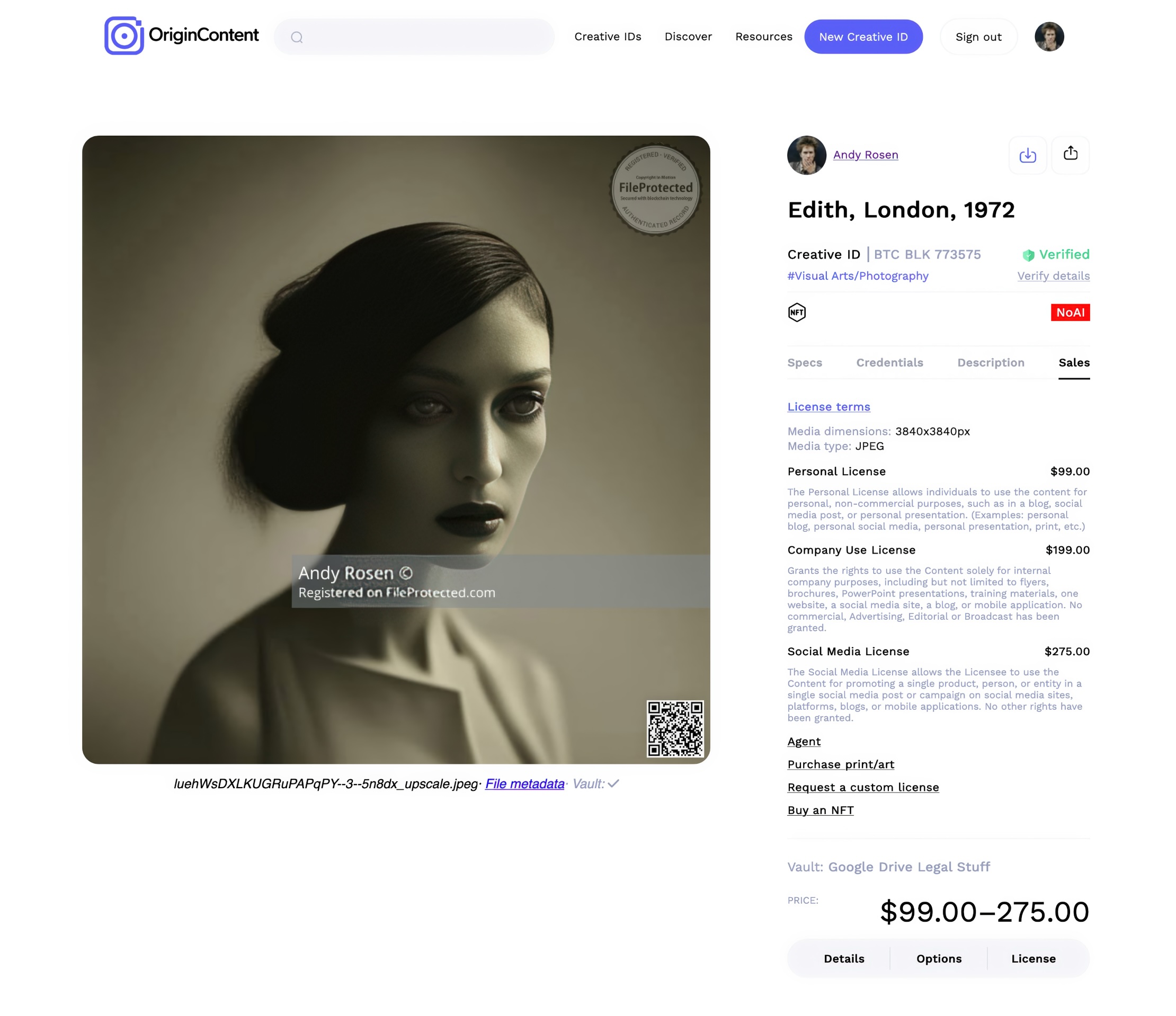
OriginContent gives every work a Creative ID.
A Creative ID is a permanent, verifiable credential that records:
- who created the work
- when it was registered
- how it was made
- what permissions exist around it
Human-created.
AI-generated.
Or hybrid.
If the work exists, its origin can be proven.
How it works
Creators connect their own storage.
Anything placed into an OriginContent folder is registered automatically.
No forms.
No plugins.
No upfront decisions.
Each work receives a Creative ID — a public reference that allows anyone to verify origin and permissions.
The original file always remains under the creator’s control.
Proof lives next to the work, not inside a platform.
Under the hood
OriginContent uses cryptographic proof and permanent decentralized storage.
Quietly, in the background.
No wallets.
No tokens.
No gas fees.
No blockchain complexity.
Creators never interact with it.
When a work is registered, its origin is anchored to infrastructure designed to last.
Even if OriginContent disappeared, the record would remain verifiable.
Creators keep their files.
They keep their Creative ID manifest.
The public reference survives.
Decentralization here is not a feature.
It’s an architectural decision made for durability, independence, and trust.
The Directory
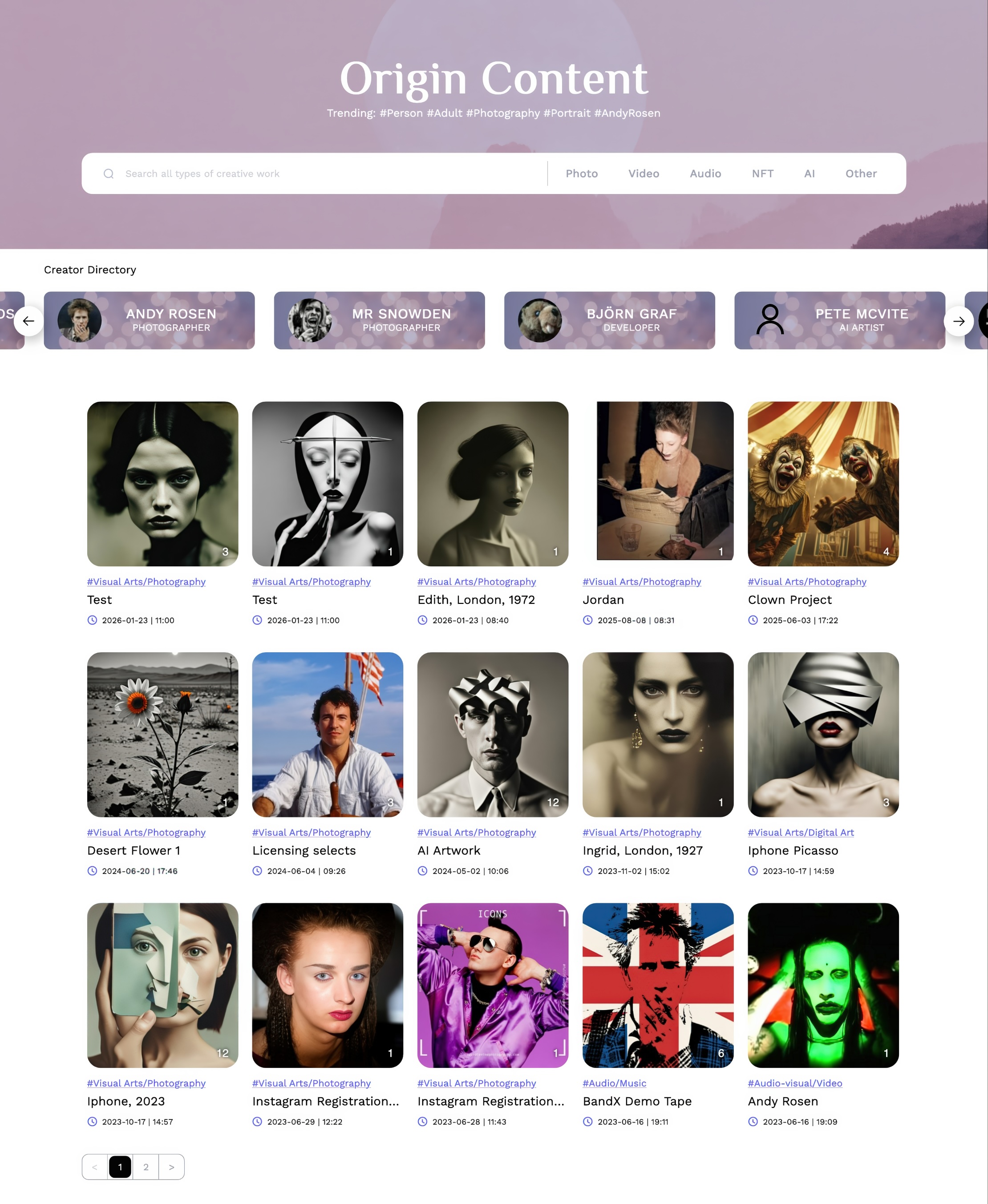
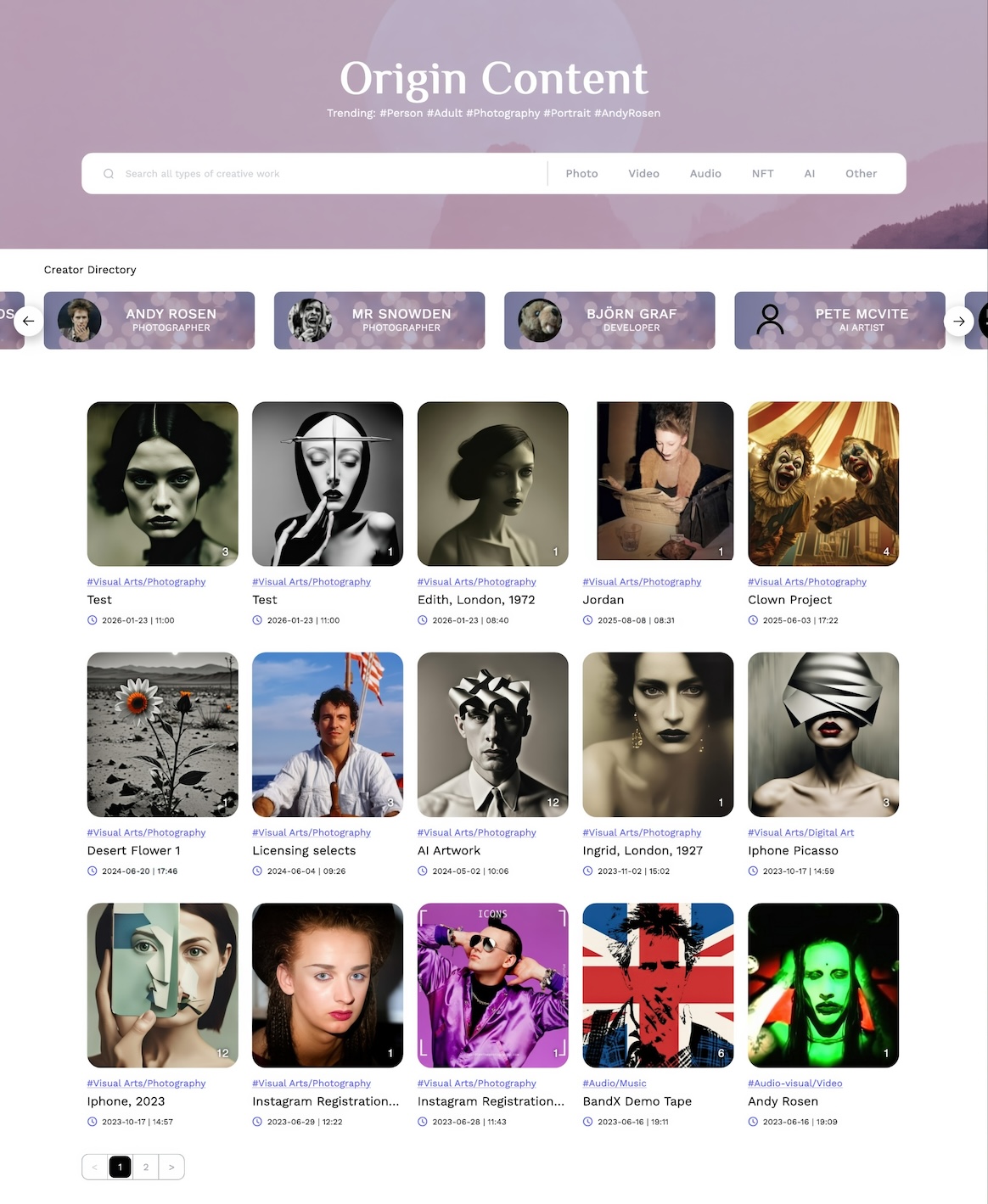
OriginContent maintains a public Directory of registered work.
The Directory is not only a marketplace.
It is a system of record where origin,
attribution, identity-linked reputation,
and declared rights can be:
searched
verified
understood
in one place.
Some works exist simply to establish authorship and reputation.
Some are licensed for commercial use.
Some are made available — with explicit consent — for training AI systems.
Creators decide.
Consent for the machine age
AI training is not publication.
It is ingestion.
OriginContent allows creators to grant explicit permission for their work to be used in training or evaluating AI models — without granting rights to publish or reproduce the work.
Creators decide:
- what is licensed
- how it is bundled
- how it is priced
- whether to participate at all
No pooled royalties.
No platform price-setting.
No implied rights.
Just clear boundaries and direct compensation.
Proof enables control
When origin is verifiable, creative work can be:
licensed
commissioned
sold directly
OriginContent does not negotiate deals.
It does not take commissions.
It does not claim ownership.
Creators set prices, define terms, and choose where transactions occur.
Proof stays constant.
Control stays with the creator.
Why this matters
When origin is provable:
authorship stops being a debate
AI work gains legitimacy
licensing becomes durable
dataset use becomes consented
sales become simpler
The bottleneck is no longer creativity.
It is credible origin and machine-readable permission.
In a world where content is infinite,
credentials become the scarce resource that enables value.
OriginContent exists to provide them.
Trust used to be assumed.
Now it has to be proven.
This isn’t about protecting the past.
It’s about making the future workable AI scale.
